


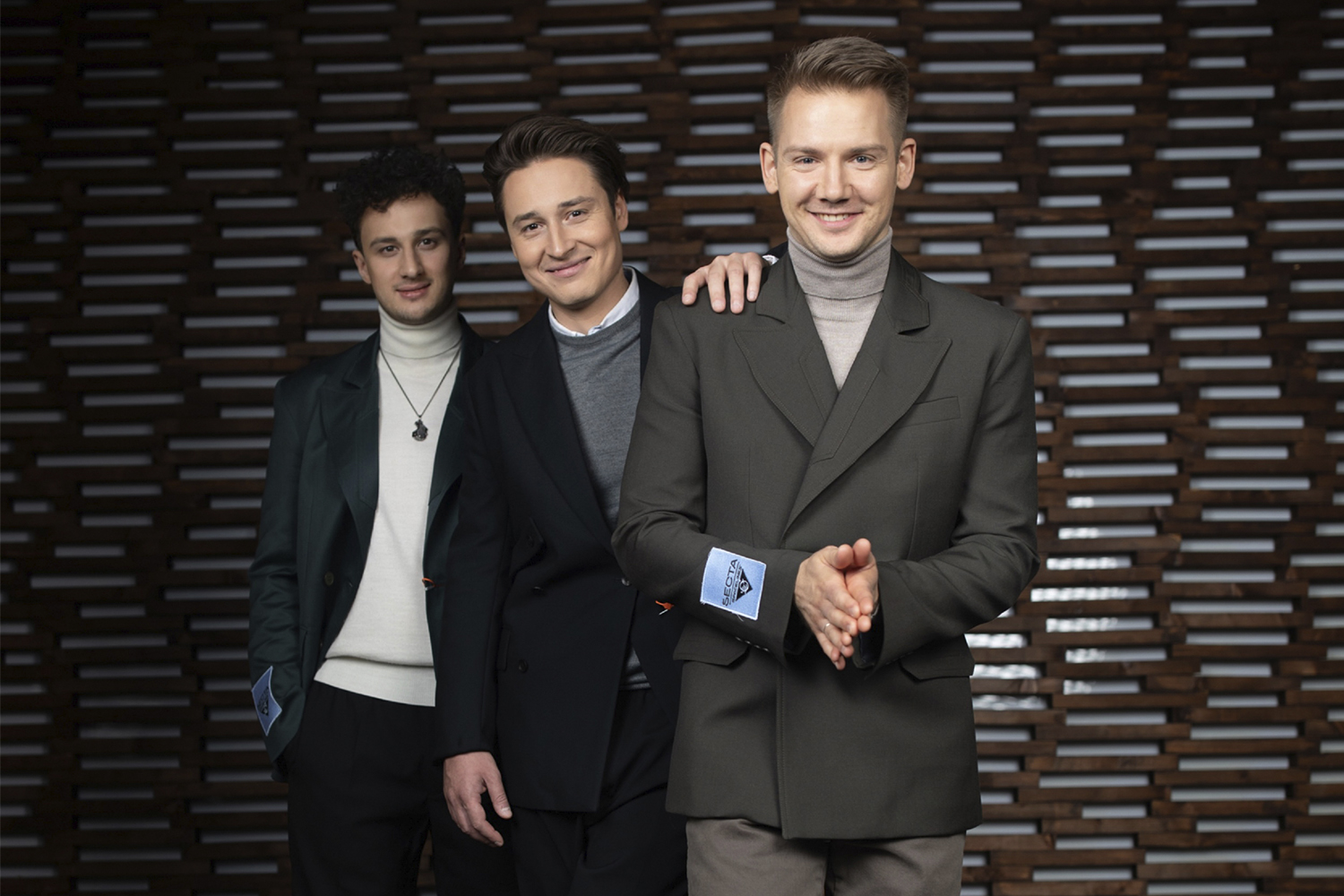
Bel Suono is the world's only piano trio. On October 7th, at Crocus City Hall, the musicians will present their new album, Universe. Kultura spoke with ensemble members Kirill Gushchin, Nikita Khabin, Anton Mosenkov, and project producer Leyla Fattakhova.

Yes, the collective turned twelve this year. Not believable. It seems like yesterday I was carrying this idea and only dreamed of creating such an unusual team.
It all started when my friend called me and said: "You're a pianist, you need to do something with the piano!" I doubted, thought that trying to create something like a classic crossover in the era of chanson flowering in Russia (and it happened in 2010) is a utopian idea. But the thought settled deep in my soul, and gradually, without expecting it myself, I began to think about it constantly. Так незаметно проект — format, style, name — and origin.

Initially, our trio was indeed formed as a team of equal musicians. As for a pronounced leader, Leyla, our producer, has always handled that role brilliantly, both organizationally and artistically.
Thus, we don't have "bears" — we are more like a "wolf pack" that does everything together and in a coordinated manner. That said, each of us has our own working methods and has accumulated unique experience. So we try to distribute work tasks to highlight our strengths.
As for disagreements, they do happen, of course, you can't avoid them! But overall, we've managed to overcome them without serious effort so far, for example, by going to a cafe together, because moving forward is much more appealing to us than arguing and standing still.
Overall, I think we're more or less on the same "taste" pole when it comes to music. All three of us like listening to rock music, both old-school "mastodons" from the seventies and eighties, and modern rebels of nu-metal, rap-rock, or post-grunge. Our preferences are quite broad: from Metallica to Kino. Plus, I personally often lean towards alternative bands (usually also with a "heavy" sound) and epic cinematic music.

I would say, on the contrary, that our musical preferences are quite different. But there are enough commonalities for our joint work. I, for example, listen to almost everything except rap (may my colleagues forgive me), and folk music has always passed me by. Lately, I've been listening to classics more often. Apparently, my long journey through rock and jazz is coming to an end — I'm returning to the eternal.

Despite all the differences, there is music we undoubtedly all love: Sergei Rachmaninoff, the band Linkin Park, for example. And then there are names closer to me than to other project members: say, Eminem, Basta.
It's always different. When the project was just taking its first steps, I almost always decided what we would play, which pieces should be arranged for three pianos. Now I happily listen to the guys' opinions: they have all become mature and interesting musicians, and of course, writing original compositions is very much welcomed and encouraged in our group.
Each of us started writing regularly while already working in the trio. For me now, it's an absolutely natural part of my work, career, and life; I truly enjoy composing music. But, honestly, I don't set any global goals in composition yet; I just try to be productive and enjoy the process itself.
Writing music and knowing that it will definitely be performed, and quite soon, is a great stroke of luck for a musician. I didn't compose for a long time because I was searching for my style, my musical language. It seems something is starting to crystallize now: the search for my own identity continues by immersing myself in various styles and genres. I hope that in the next thirty years or so, we can still compete with neural networks in music composition (smiles).
As for me, the process of arranging music, including my own, is perhaps even more interesting than direct composition. It's in arrangement that I find new timbres and their combinations, and so my creative ambitions are directed roughly in that area.
It's a wonderful thought, and it's absolutely true. The grand piano is like a lion in the animal kingdom — the most majestic and the most beautiful. Plus, it's the most universal: you can perform music from any era on it, solo or in an ensemble, in a large hall or a compact studio. The grand piano is always appropriate and timeless. It's also important that it's not difficult to master at a basic level — all the keys are in front of you, easily accessible, yet at the same time, you can and must endlessly perfect and refine your skill.
I agree. The grand piano is indeed the most universal instrument, covering all possible registers and most existing textures. You can play almost anything on it.
To what my colleagues have said, I can only add one thing: the person who uttered these beautiful words deserves praise and respect for their insight.
As in any profession that requires a long learning path from childhood, music transforms anyone who masters their instrument at a high level into a kind of "superman." It's when you can easily, even if seemingly, create something inaccessible to others.
Another obvious plus is that through music, you get a wonderful opportunity to express your feelings and emotions — when words aren't enough. It doesn't really matter if there are listeners nearby or not. Music helps you know yourself better and will always offer support in difficult times. And the musical community is a circle of interesting people, of whom you could say they are "different," in a sense even aliens, why not? (smiles).
On the other hand, it's hard work, and constant work — to maintain the form built up over years of many hours of practice. And if we're talking about composing music, it's even more interesting and serious. Of course, when inspiration comes — wings grow, you're in the flow, everything is great. But frankly, that doesn't happen very often. The rest of the time, working in the musical field is routine, hard, monotonous, and often fruitless.
The main, magical feeling that music gives is the confidence in what you're doing. And when you realize you're doing something at a decent level, the desire to share the fruits of your labor naturally arises. When you enjoy performing, people pick up on it non-verbally.
The most beautiful thing about music is its intuitive component, at all levels: from creating and performing a piece to improvising. The hardest part is achieving the level of mastery that allows this intuition to exist harmoniously within the artist.
Let's draw a parallel with literature. Yes, the alphabet has a few more letters than the staff has notes, but the principle is the same. Theoretically, yes: words and their combinations that can be rhymed and rearranged are not infinite. The same can be said about ideas and plot concepts. Yet, I'm sure we're not threatened by a shortage of new opuses in the epistolary genre. The same goes for music. Over several thousand years, art hasn't exhausted itself yet and doesn't seem to be planning to.
I'd like to give an example with a deck of playing cards. To this day, there are combinations in which the cards haven't been dealt yet. It's the same in our field: besides melody, rhythm, and harmony, there are other means of musical expression, like timbre. And given modern synthesis capabilities, it's entirely possible to get a sound that has never existed before.
An analogy with chess comes to my mind. No computer program has yet been able to calculate all possible positions in this game. Although it's only about 16 pieces placed on 64 squares.
It's roughly the same with music. Multiply twelve notes by several octaves, and we get 88 in the piano version. Music usually doesn't consist only of a single-voice melody. It has some rhythm. There are a huge number of rhythmic patterns. Multiplying these two parameters gives us an incalculable number of options. And if you consider that you can play not just one note at a time but several simultaneously, you get what we call harmony. So there's a whole abyss of various combinations.
And then there are timbres, registers, time signatures, tempos, texture, dynamics, and so on — so music is inexhaustible in its possibilities. The limiting factor is our hearing, which cannot distinguish too subtle and complex things, and therefore cannot derive pleasure from music striving for overly complex combinations.
This is our sixth studio album. So, roughly once every two years we release an album. The title Universe came from the realization that we perform such diverse music that it can be compared to a huge universe — just as boundless and all-encompassing as our repertoire.
During the recording of the album, representatives from the Faculty of Geography at Moscow State University approached us with a proposal for a joint project, whose main message would be preserving and caring for our planet. That's how the title track came about, for which a music video was later shot. It tells the story of true romantics, people devoted to their profession — young geographers and researchers who study our beautiful Earth, its depths, and do everything in their power to protect the planet from upheavals...
The album also includes several striking classical themes for which the guys made modern original arrangements: among others, fragments from Carmina Burana, the "Moonlight Sonata," and a theme from the opera Carmen. We recorded an arrangement of the famous "Besame Mucho," and, of course, each soloist contributed their own original compositions, which, in my opinion, are very worthy... The album is already available on all digital platforms, and, of course, it will be available for purchase on CD at all our concerts.
Perhaps most inspiring are real success stories — about how people managed to overcome all difficulties, opposition, and kept their faith in themselves, becoming better and stronger.
Travel and the impressions that last long after. Also, the music of other composers, which evokes a sense of "healthy envy," never leaves me indifferent.
A difficult but interesting question. Let the list be this (the order is arbitrary, but these musicians came to mind in this sequence).
Sergei Rachmaninoff — one of the best pianists of all time, possessing an inhuman compositional talent and still exerting a huge influence on the entire music industry. His Third Piano Concerto is, in my opinion, the best thing ever written by human hand.
Ludovico Einaudi — this contemporary Italian expresses his ideas with rather minimalist means, as if cutting away everything superfluous. His music is imbued with deep, quiet psychologism; it's like turned inward.
Jon Lord — the brilliant keyboardist of Deep Purple, who was a great innovator and experimenter, managing to befriend hard rock and Baroque music. On his Hammond organ, he achieved an amazing sound: "heavy," overdriven, almost like an electric guitar... I really like how Evgeny Kissin plays: academic and very fresh at the same time. And Keiko Matsui is simply wonderful (smiles).
Vladimir Sofronitsky exemplifies an absolutely free pianist in the classical direction. He always had multiple versions of performing the same piece, equally good in quality but potentially quite different in content. That's why listening to his recordings is especially interesting, even for the same opus. And, of course, he's the best interpreter of Alexander Scriabin's works, my favorite composer during my student years.
Jazz pianist Keith Jarrett, with his strong classical schooling, has exceptionally diverse work. His culture of sound production would be envied by many academic masters. He is characterized by a subtle attitude towards musical texture and boundless freedom in improvisation. In short, he's a cosmic pianist!
Bill Evans — a brilliant pianist for an aesthete audience. His music is alien to external, superficial effects — only concentration, penetrating the depths of the piano. I also feel close to Grigory Sokolov, any recording of his is exceptionally good, and Vladimir Horowitz, without some of whose recordings piano music itself is hard to imagine.
Sergei Rachmaninoff — here, as they say, no comment... The Hungarian musician Péter Bence is not only a wonderful pop pianist but also an extraordinary showman. Sometimes I feel very close to the mood of Ludovico Einaudi... And, perhaps, I'll leave it at that — not because I have few favorite luminaries of the black and white keys, but because in most cases, frankly, I prefer to listen to non-piano music (smiles).
Undoubtedly, yes, music was created for exactly that. Every artist, taking the stage, should always remember why they are doing it. You can't just formally "go through the motions" — that's at least disrespectful to the people in the hall spending their time and money on your show.
Regardless of anything, every concert is a chance to share the best that is within you, to realize your dream, to inspire someone completely unfamiliar to do something extraordinary. It's both a privilege and a responsibility, and, if you will, a way to leave your mark on history.
In every person, something good and something quite nasty coexist in an amazing way. Therefore, of course, I want to awaken in the listener the brightest feelings across the broadest spectrum through my music. Changing the world probably won't happen, but positively influencing a certain number of people around you is quite achievable.
Honestly, here I am extremely prosaic: taking the stage, we set ourselves the task of showing the best of what we have achieved in rehearsals. In this sense, I envy the listeners in a good way: they can simply listen to the music — without analyzing, just giving in to emotions. An artist cannot afford such luxury.
As for music's influence on the world and its possibilities... I think that beautiful art, a priori, cannot provoke destructive thoughts. And that means we, one way or another, are making the world a tiny bit better.


