


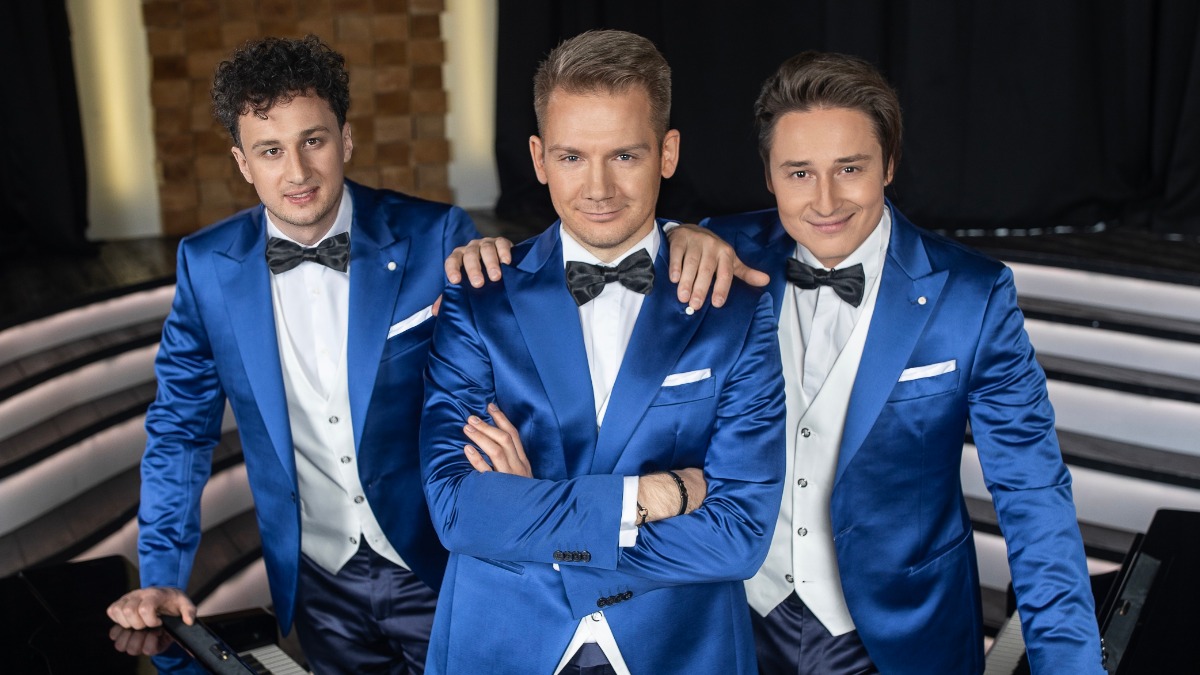
The world's only piano trio, Bel Suono, will present a new program at a concert at Crocus City Hall on October 7
Vechernyaya Moskva spoke with soloists Kirill Gushchin (K.G.), Anton Mosenkov (A.M.), Nikita Khabin (N.K.), and producer Leyla Fattakhova (L.F.) about how they manage to perform classics in a way that makes listeners' emotions run as high as at rock star concerts.

In music, this means a combination of styles. We try to convey beautiful, complex music in a format understandable to a wide audience.

We try not just to perform what was written before, but also to bring our own vision. To create something at least somewhat comparable to the original. It sounds ambitious, but we strive to present a piece so that next to Bach's name, through a dash, stands Khabin's or Mosenkov's name.

For me, the model of classical crossover is Bach's Toccata in the version I heard from the guys when I joined the group. It's reimagined, changed towards modern rhythms, yet the material is very recognizable.

We maintain a serious approach to the classics, but at the same time, we demonstrate bold solutions. And the most frequent comments viewers leave on our social media pages after concerts are: "Vivaldi would be delighted with your approach to his music," "Bach would have liked it."
The guys have a brilliant classical background. All are graduates of the Moscow Conservatory. Imagine, to become a brilliant musician, you have to study from the age of 5 or 6—first at school, then at a music college, then at the conservatory and graduate school. And to become a brilliant crossover performer, you have to develop in other genres, master modern computer music programs, the art of arrangement, and listen to different musicians. Constant development is essential.
Exactly!
In our program, there's a number called "Flight of the Bumblebee on Sabers," which combines both Rimsky-Korsakov's "Flight" and Khachaturian's "Saber Dance." It's a very powerful arrangement. It combines several themes. And there are many such arrangements. For example, Beethoven's "Für Elise" is combined with Oginski's "Polonaise."
Vivaldi's "Winter" is our everything. I like our Bach Toccata and Fugue in D minor. It's quite far from the classics and the original, but it seems convincing enough.
Pianists are always solo performers. They are not orchestra musicians playing the same part. At the piano, each has their own part. Moreover, each writes music and each has something to show. But it's healthy competition; it spurs them on to make a number better and more interesting. The guys are versatile and individual; they complement each other.
Probably, Leyla was the first. She gathered and organized us. Bel Suono is her idea. I have the longest history in the group — 10 years. Then Anton came. He fit in without any problems; things immediately heated up. And when Nikita came, it really got hot because there was no time for adaptation! We are lucky: we know why we play. So there have been no problems in the group. Only discussions, sometimes disagreements.
In my opinion, nothing prevents this desire from being realized. It's not forbidden. It's just that during a performance, your energy is so drained that you simply can't hog the spotlight indefinitely. Two or three minutes is enough.
Our desire to popularize Soviet classics often finds no response from composers' heirs. For the right to make arrangements of songs or melodies, some of them demand exorbitant sums. Fortunately, the guys write their own music, and we have a vast amount of classical repertoire at our disposal.
Three grand pianos are a complex format. Few concert halls can boast such a number of acoustic instruments, so digital instruments, which have traveled half the world with us, come to the rescue. But if the hall has three acoustic grand pianos, we always prefer them to digitals.
Of course, we do that regularly.
It's not like after three hours of rehearsal, everyone scatters at the bell and nobody calls or texts for a week. We are constantly communicating on various topics, including personal ones. But everyone has their own life and interests. We seek balance. Sometimes we take a break from each other to avoid an overdose of team spirit (laughs).
We often start the day by writing in chats what our current weight is (laughs).
We have an unspoken rule: everyone should look good and be in good physical shape. Initially, I was driven by the idea of overturning the audience's common perception of pianists — plump, shaggy, practicing eight hours a day and not noticing anything else. I wanted to see handsome, charming, artistic young men in the group. After all, the main audience at concerts is women.
People come to watch. And we absorb 70 percent of information with our eyes. Then the auditory system kicks in. But if the picture isn't good, we only hear at half strength.
There are cities and countries with a warmer and more temperamental audience. For example, in the south, in Central Asia or Transcaucasia, where concerts end with long photo sessions and autographs.
We don't aim to make our concerts resemble pop shows. We have a slightly different aura. People come to us to be inspired. On October 7th, we have the premiere of our new program, "Universe." This is a new stage in a long journey.
First of all, I wish you health, happiness, understanding, to keep the child within you, so that you speak the same language with your children. Parental love is unconditional and wonderful! When I write these wishes to you, I imagine my parents, to whom I am immensely grateful for everything!
Bel Suono translates from Italian as "Beautiful Sound." The world's only ensemble that plays on three grand pianos simultaneously. Founder and producer — pianist, graduate of the Tashkent Conservatory, Leyla Fattakhova. Soloists: Kirill Gushchin, Anton Mosenkov, Nikita Khabin. Over 12 years of existence, Bel Suono has released six albums and won the love of audiences in Russia and around the world.
My parents are engineers, but both studied at music schools as children. And my aunt is a pianist, a graduate of the Saratov Conservatory. She helped me take my first steps on the piano. At the age of six, I was sent to the Music and Aesthetic Lyceum, modeled on the classical music decade schools. After graduating, I went to Moscow, studied at the Moscow State Tchaikovsky Conservatory and completed my postgraduate studies.
At the choreographic school where my parents sent me, there was a subject called "general piano." These lessons interested me more than choreography. I decided to study music professionally and transferred to a music school. After that, I entered the Tchaikovsky Academic Music College at the Moscow Conservatory, and then graduated from the Moscow Tchaikovsky Conservatory.
There were no musicians in the family. One day, my father brought home an old upright piano in a trailer. In a neighboring village, there was a small music school, but with very dedicated teachers, which I attended. A year before entering college, we moved to Magnitogorsk so I could continue my studies. After college, I went to the Moscow Conservatory to study in the class of M.S. Voskresensky, and then completed an assistantship-internship at the Moscow State Conservatory.
I would gladly work with cars — participate in races or open my own auto service. I closely follow the F1 championship.
A programmer or mathematician... A paradoxical mix — creativity and exact sciences. I probably wouldn't be truly happy and wouldn't feel in my element if I hadn't become a musician.
I wanted to become a footballer, for which I had no talent. It's good that there were no sports sections in our village, otherwise there would have been another wannabe footballer. Now it's hard for me to imagine life without music. If not for it, I would have gone into journalism. I like honing a thought, trying to present it convincingly.


