


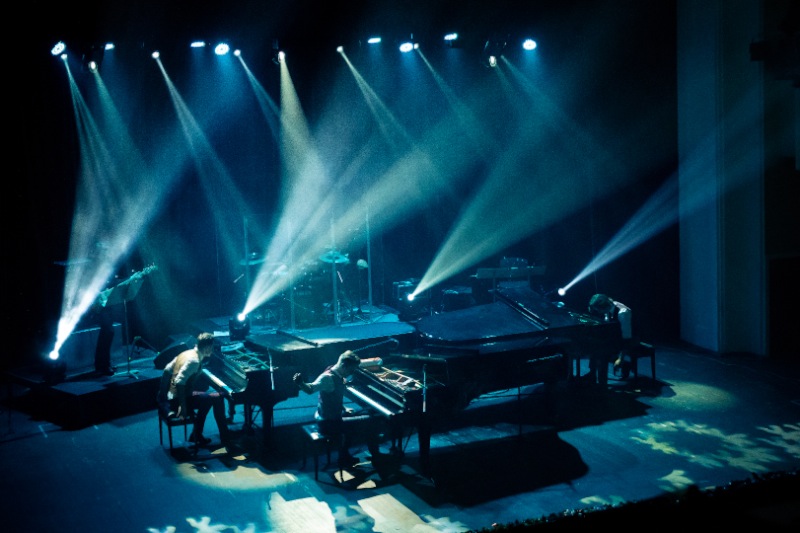
It's probably hard to imagine a more unique project than a piano trio.
The format is quite atypical and, besides the skill of the musicians and arrangers, requires solving a whole range of tasks from the sound engineer/technical director and producer.
We asked the producer of the Bel Suono project, Leyla Fattakhova, and sound engineer Sergey Aktush to tell us how these tasks are solved.

Many years ago, when I was studying at the conservatory, I had a penchant for "pop" classics, in the good sense of the word. I include Bizet-Shchedrin's "Carmen Suite" or Vivaldi's "The Four Seasons" in this category. This is such popular classical music that it has moved into the category of hit music. Now there are many opportunities to perform it in your own way, in a new way, considering the realities of the time.
It would be foolish not to use this chance. I worked in show business and record companies for a long time: such as the Soyuz studio, ORT-Records, NOX Music. Then I had my own PR agency, I worked with many artists and not only. When all this was known and to some extent got boring, the thought of my own project came, and a year later it took shape in Bel Suono.
A piano trio — because I am a pianist and seriously studied music from the age of six: music school, college, then conservatory. I considered this the meaning of my life literally until the end of the conservatory, until the question arose: where to go to work? Teaching at a music school or working as an accompanist, as is still offered to musicians with such training and a serious wealth of knowledge, absolutely not matching their level? But there are exceptions: solo projects, for example, like ours.
All three soloists — Kirill Gushchin, Vasily Opalev, and Anton Mosenkov — graduated from the Moscow Conservatory and joined the Bel Suono group after a serious selection. Excellent command of the instrument was not enough in this case. They needed to look good. In addition, skills such as improvisation, composition, transcription were welcomed — all the things they don't teach at the conservatory, and in our time it was even forbidden. Now education has become more loyal; there is an understanding that it's easier for a musician who is a "multi-tasker" to survive.
Returning to the origin of the idea, I wanted to do something special. It was only about grand pianos and — naturally — not just one. One grand piano is a solo pianist, two is a duo, of which there are many, and for which there are many works. We were going to create something original: to play in a format that didn't exist. After researching the market, I realized that such a group didn't exist yet.
From the very beginning, I was sure this was an international project, as there would be no language barrier. From many name options, we chose Bel Suono, which in Italian means "beautiful sound," and we try to live up to that.
You have to look for people as crazy as we are, because we drag three grand pianos around with us: all over the country and abroad. Since finding three good-sounding acoustic instruments in most halls is difficult, we bought three digital Rolands that meet our requirements. Of course, in halls with three acoustic instruments in good condition, we always play only on acoustics.
For example, in Moscow — except for some mass or corporate events. If it's a public concert — at the State Kremlin Palace, the Moscow House of Music, the Grand Hall of the Conservatory, Crocus City Hall — we play only on acoustic grand pianos. They have a brighter sound palette and are visually more beautiful. The only exception, perhaps, is the Cathedral of Christ the Savior: we played on digital instruments there.
For a sound engineer, mixing three grand pianos might seem like a simple task. In fact, there are no other groups with three instruments, each occupying the entire frequency range, and when they play simultaneously, it creates certain difficulties for the sound engineer.
Our touring option is electronic grand pianos. They are also used at solo concerts, but it's not the preferred option, as they sound a bit poorer than live ones. You don't get the "acoustic pleasure" between the three pianos. Although the Roland electronic grand pianos sound good, are compact, and can be set up in thirty minutes by one loader and one specialist. A very high-quality imitation of a real grand piano that you can actually take with you. It's hard to find three good concert grand pianos, especially far from central cities.
Firstly, they have high-quality key mechanics, close to natural. Secondly, a pleasant sound.
Ideally, they should be three concert Steinways.
Here I would like to mention another partner of ours, Yamaha, which, like Sennheiser, has been working with us for a long time and also helps us a lot, providing instruments for concert performances and rehearsals. And we are very grateful to them for that.
Mainly in two. In large halls (the Kremlin Palace, Crocus City Hall, the House of Music, the Grand Hall of the Conservatory, or the BKD "Oktyabrsky" in St. Petersburg), we usually perform with a reduced symphony orchestra. We always add our own drummer, who constantly works with us, and a bass guitarist, who also participates in all concerts, regardless of the lineup.
The second lineup we call the "band," consisting of keyboards, drums, and bass guitar. This is the touring option. Of course, we didn't get there right away; we grew into it gradually. And for the last year and a half or two years, we've been traveling to concerts only with this lineup, because playing with a backing track, as we did initially, is no longer acceptable for us. We've reached a level where even outside Moscow, the group can afford to show the audience a fully live lineup. I hope we'll go even further and maybe also bring a string quartet, percussion, and perhaps a musician who plays several wind instruments, because different pieces feature solo parts for various instruments. We'll most likely try this format at the Christmas concert on December 22nd at the House of Music.
This, one might say, is half of my gray hair. Despite having already had such a big concert at Crocus, the format here was more complex: we used screens, programmed lighting for each piece. Video content was being prepared, and at the last moment we were forced to change contractors.
But professionals do exist, and two weeks before the concert, they managed to redo the video content! The group performed with the Moscow State Symphony Orchestra conducted by Ivan Rudin, with conductor Alexey Chuykov. We have been closely collaborating with this orchestra for two years now. The guys also like working with us, and when musicians are passionate about their work, that's the main factor for success.
This is a very good question, because the difficulty always lies in ensemble playing, especially at concerts. Not only do you need to hear your two pianist partners, but you also need to hear either the band or the orchestra, and therefore the role of the sound engineer in our project is almost paramount. For lighting design, you can come up with a million options. As for sound, we built the concept step by step.
The approach is a bit different when we play on digital pianos versus acoustic ones. But there's always in-ear monitoring, the miking of acoustic pianos, which Sergey Aktush can tell you more about. With digitals, it's simpler: they aren't so demanding. The drums, all instruments a little bit, and, of course, the soloists must hear themselves and their ensemble partners are definitely in the in-ear monitors. We've been working with Sennheiser for about five years now, and they help us tremendously.
At big solo concerts, like at the Kremlin, we always work with my colleague, monitor sound engineer Ilya Lunev. We mainly use in-ear monitoring: Sennheiser IE 40 PRO, Sennheiser EW 122P G4 wireless system, Sennheiser EW 300 IEM G3-G-X monitoring system. As a rule, the stage is quiet.
In addition to in-ear monitoring, only side-fills remain on stage, which work for the orchestra. We have about 12 in-ear monitor mixes: three soloists at the pianos, bassist, drummer, keyboardist, conductor, individual soloists in the orchestra, and side-fills. Thanks to Sennheiser, we have five in-ear monitoring systems: for the three soloists, the bass guitarist, and the keyboardist.
We've known Sennheiser for a long time. When we needed in-ear monitors for our concerts, we met with the company's specialists and the issue resolved itself. We've been working with their equipment ever since.
Currently, we work with a system of three or four microphones. These are several condenser microphones inside the piano, a boundary layer microphone attached to the piano lid, and an additional microphone underneath the soundboard. We use dynamic microphones and boundary layer microphones from Sennheiser, the E901 and E902 — with a rich low-frequency spectrum. Specifically, the microphone is placed under the soundboard to boost the low-frequency spectrum. That's the Sennheiser E902. The cardioid E901 is attached to the lid accordingly. Inside the piano, we used the E914 for a very long time. At the Kremlin, that was the exact setup used. Three or four microphones per piano.
We mic the orchestra with a combination of microphones. On drums, we have a long-standing, reliable Sennheiser kit. It's very easy to find on tour and you can always carry it with you. These are the E602 and E604 microphones. A standard drum setup. For the orchestra, there are general microphones, one microphone per stand, also Sennheiser E914s.
Yes, precisely for this reason, for the concert at the Kremlin, we called our long-time partners, the company "Spin Music Service." They handled, among other things, frequency coordination. We didn't have a single dropout, and everything was excellent throughout the concert. The guys set up the systems professionally; nothing dropped out even during soundcheck. Sennheiser wireless systems are easy to configure: there's special software, everything is managed over the network.
The only reason to contact technical support is for headphones, as in-ear monitors tend to get dirty during use. There are several service centers you can always contact; everything is resolved very quickly.
Sennheiser has many quality products: both wireless systems and microphones, and additional advantages like software for managing wireless systems. The rack with wireless systems is connected to the general network, and from my laptop at the FOH position, I can check what's happening with the monitor lines, if anything has dropped out, the signal quality, etc. And reconfigure it all if necessary. Our choice was influenced by the ease of use of the equipment and the possibility of its integration with the mixing console, meaning network control.
Whether it's a need for headphones or help with a technical issue, above all I value human relationships, when people understand that we are partners. Not when the contract says "you owe us" and "we owe you" and "try not to fulfill any of the contract clauses." Sennheiser always responds to any of our requests, gladly shares new products. We also always respond to their requests: we perform, participate in various events, do joint projects, photo shoots. We really value our partnership.
There are more and more tours. Our autumn is already packed tightly, like never before. This didn't come right away. The first five years we survived. There were occasional major events, we worked at the opening of big festivals, sometimes performed to highlight the uniqueness of an event's format. But nevertheless, the genre is so specific that, for example, for the "Kultura" channel, Bel Suono is too pop and modern, and for channels that broadcast pop star concerts, it's too classical.
We stand in the middle and very rarely get into big concerts. Maybe that's not so bad, but we lose part of the audience that watches TV, especially far from Moscow. On the other hand, now there is the Internet, which allows us to promote the project and show everything we are capable of. Ninety-five percent of people learn about us from the Internet. Instagram, FB, VK, our YouTube channel — and now our halls are always full. Starting from 2016, we always have sold-out shows. The very first was at Crocus with 6000 spectators, then at the House of Music (1700 spectators) and the Grand Hall of the Conservatory (1700 spectators). Now — a sold-out show at the Kremlin (6000).
Since the beginning of 2017, we started touring, and I became both the producer and promoter of all our concerts, not only in Moscow. In practically 85% of our concerts, I am also the organizer. We rent the hall, do the advertising ourselves, promote the project, ensure sold-out shows, and do not rely on third-party organizers who don't know the project well and don't understand what kind of advertising to do, usually working the old-fashioned way. We make beautiful posters, shoot beautiful videos, and try to convey to the public what this project is about.
When a social media user sees how it sounds and how it looks, they want to see and hear us live. At our concerts, there are many young people and children. Many intellectuals who know classical music and want to hear it in a new interpretation. There are also people for whom classical music becomes a discovery. The popularization mission in this case, probably, is one of the main ones: after our concerts, many people want to listen to classical pieces in the original or buy all our albums on iTunes, which is very nice.
The plans are grandiose. On October 5th, on Music Day, there's the traditional concert at the Grand Hall of the Conservatory. Then tours in Siberia, in the southern region — Sochi, Krasnodar, etc. Then for the first time we go to Severodvinsk, to Lithuania, three big concerts in Poland, where we are very loved.
On our very first visit, we had a sold-out hall of 2500 people. An incredible audience. In Poland and Lithuania, we will now be working at stadiums of 4000 people. The most incredible audience after Moscow is in Poland and Georgia. In December, we repeat the success of the May concert in Georgia, as many couldn't get into our performance then.
We are going to Baku for the first time. The schedule for next spring is almost full. We are going to 2000-seat venues in Saratov and Voronezh, and once we performed there in small venues — 500-700 seats. If a city doesn't have large venues, we give two concerts a day. For example, in Sochi, tickets were sold out instantly, and at the request of the audience, we opened an additional sale. The plans are grandiose: Germany, other European countries, we are negotiating with China, with America. I won't rest until we perform at the Albert Hall and Carnegie Hall! So there's a lot of work.
Come to our concerts!


